
The financial media occasionally provide some really useful information to help you make investment decisions. The following website is one such resource if you are buying North American based companies. See http://money.cnn.com/magazines/business2/b2fastestgrowing/full_list. Among the benefits of investing in the USA are:
1. The better online financial resources - all in English
2. The greater range of enterprises to invest in - number and industry diversity
3. The greater trading liquidity
The benefit of this list of fastest growing enterprises is that it might at some point help us to identify a future 'Google'. The flipside is that because these companies are 'growth companies' they trade at a premium - that is they are trading on a high PE ratio. The high rating might be justified, particularly if:
1. The growth in earnings has been maintained over a number of years -say 5 years or the CEO has a very good track record elsewhere.
2. The company still holds just a minor market share
3. The company shows a propensity for acquisition and has a successful track record absorbing those take over targets
4. The industry is in need of consolidation
You can use the link to look at the best performers over a number of years. I personally however like companies with a negative track record because at some point:
1. They will be taken over or turned around by new management
2. They become over-sold, often to the point that they are trading below asset values
 Global Mining Investing $69.95, 2 Volume e-Book Set. Buy here.
Author, Andrew Sheldon
Global Mining Investing is a reference eBook to teach investors how to think and act as investors with a underlying theme of managing risk. The book touches on a huge amount of content which heavily relies on knowledge that can only be obtained through experience...The text was engaging, as I knew the valuable outcome was to be a better thinker and investor.
While some books (such as Coulson’s An Insider’s Guide to the Mining Sector) focus on one particular commodity this book (Global Mining Investing) attempts (and does well) to cover all types of mining and commodities.
Global Mining Investing - see store
Monday, October 22, 2007


Tuesday, September 25, 2007
Australian Agricultural Company (ASX.AAC)
I have previously made mention of the agricultural commodities - and the potential of companies like Qld Cotton, Namoi Cotton, Australian Wheat Board, Graincorp and Australian Agricultural Company. Since that time, we have seen the takeover of Qld Cotton by a Singapore-based company, and AWB hit by a number of law suits. The problem is that there isnt much exposure to the agricultural sector on the Australian ASX. The bulk of farms remain private family corporations. I suspect this is about to change for 2 reasons:

1. High levels of debt
2. Drought has undermined revenues
3. Hedging debacles
4. Rising costs for inputs, eg. Fuel, fertiliser, insecticide
5. Low prices for alot of commodities
6. A strong $Aust - now $0.87 to $US
Travelling through the Northern Territory, Qld and NSW, it was readily apparent to me that:
1. Farmers in the North are till benefiting from very good unseasonal rains in May'07 even though crop farmers are watching their crops fail. Pastures in the north are well grassed.
2. Some commodity prices are up, but some are down due to drought, mixed fortunes of those crops used by biofuel production.
3. Input prices like fuel and fertiliser have increased considerably in the last 6 months
So I think farm failures are going to result in a number of new ASX listings as agricultural commodities rise. Why do I think agricultural commodity based stocks are going to perform well:
1. More takeovers - from Japanese, Chinese, local and US companies particular
2. Higher commodity prices - stronger demand for beef from Asia in particular, strong demand for grains for energy and feed, the flow through of input prices
3. Final end to the drought
4. Consolidation of family farms offering expansion upside
5. Growing speculation on agricultural based commodities by financial institutions
Its not a sector that I know much about but I would also expect trading in water rights to be brisk and I suspect a lot of money will be made there. But as far as equities are concerned, I like Australian Agricultural Company (AAC) because:
1. It is a well managed company
2. It is a pure beef exposure - pasture and feedlots
3. The outlook for beef demand in Asia I think is particularly good
4. Geographic diversity - they own 1.2% of Australia (8mil hectares), with their stock dispersed among a multitude of properties - se www.aaco.com.au
5. Improving rainfall - despite the drought, the rainfall in the Carpentaria region (West Qld) is has been increasing over the last 50 years. The paddocks are currently well grassed.
6. The prospect of the drought ending - this is already the worst drought since the 1930s
Technically the AAC chart looks good as it consolidates at its moving average. Currently trading at $2.75, with an earnings yield of just 1.1% and a dividend yield of 5%. This implies to me that the stock is only just recovering from drought-affected earnings. The clear intent here is to position in a stock that will benefit from those unseasonal rains, higher future commodity prices and any cessation to the drought - when it finally comes. Given that we are breaking 100yr records, the end to the drought cant be too far off. In case you are thinking that the drought is really climate change - consider that over the last 50 years, the locations of AAC properties have actually benefited from a significant increase in rainfall - thats in the Carpentaria region.

Monday, August 13, 2007
Buying value for money - profiting from crises
There are different ways of identifying good investment opportunities. There tends to be several reasons why good buying opportunties arise:

1. Poor management generating poor returns on investment. These companies can offer attractive buying because such companies are often taken over by competitors who think they can do it better.
2. Bad news creates opportunities because disgruntled shareholders tend to dump the stock. They dump the stock out of frustration, minimise exposure to more bad news, to punish the management. Whether its a law suit, a health scare, an oil spill, a mine collapse, or an earnings downgrade often bad news can have a silver lining.
3. Market shocks provide a great opportunity to buy stocks. The biggest challenge is identifying the best types of stocks to enter. They might be the worst performers, or you might buy good stocks similarly hit by the generally bad market sentiment. The best opportunities are presented by smaller stocks with good cashflows, though go for those with big share registers as these are more likely to experience many shareholders dumping the stock. In these circumstances, there is competitive pressure to unload the stock. Illiquid stocks tend not to display the same level of selling pressure and recover more quickly....thus illiquid stocks dont have the same psychological 'panic symptoms' that we like to see.
Trading strategy
The challenge is to understand the industry, how bad the news is before others, so that you can profit from any turnaround. There are 2 tools that you can use to profit from these opportunities:
1. Fundamental analysis: This is where you attempt to quantify the value of the company or the value written off, so you can determine if the comapny presents good value. You need an indication that the market has over-reacted because we are looking for bargains. The best indication is the pace of the fall, the amount of share turnover. We are more likely to see bargains if a higher volume of shares are traded, and we are more likely to get a position.
2. Technical analysis: We can look at charts and see the support and resistance levels, but its not necessarily easy to know which support a share might fall to. You might think it has support, then it falls further on its own or driven lower by further news.
If you can't quantify the value of the company post-bad news, you can still make money by using charts. In fact charts are critical for understanding
Want a strategy for buying blue chip stocks that will out-perform the market? Look no further than those making the headlines....for bad news that is. There are different strategies for different circumstances.
1. Short term strategies: This is where you are following sudden news announcements and you see an opportunity to profit from over-selling of a stock driven by shareholders motivated by fear. eg. In Japan there was a health scare when Snow Brand Milk reported that several customers had fallen ill after drinking its contaminated milk products. The CEO resigned, consumers stopped buying Snow Brand products, and millions were wiped off the companies stock value. Its safe to say however that the stock was always going to be over-sold. Why? Because the share price action was driven by short term news. Manufacturing capacity is very easily mobilised to produce new brands so a manufacturer can very easily regain the confidence of consumers if they offer discounts and sack senior staff. Also such companies offer compelling takeover targets. Whats important is that you recognise that the value of any asset is the discounted value of any cashflow. So a loss of income for 1 year has a mild significant (5%) on corporate value, but not the 20-30% we see shares sold to. The more tragic the news the better the buy because the greater the pressure for action.
2. Longer term strategies: This is where a company has been reporting a succession of poor results or bad news reports that have pushed the stock to new lows. The best way of finding these stocks is on the internet. CNN, Forbes and other media groups often report the best and worst corporate performers. eg. http://money.cnn.com/galleries/2007/fortune/0707/gallery.global500_losers.fortune/17.html
Trading tips
There are several things we can do to profit from bad news:
1. Dont always be fully invested otherwise you will likely never have spare cash for such opportunities. Alot of people feel compelled to always have their money in the market. Their attitude is...'you can't make money if you are not in the market'...true, but you can save alot.
2. Always have a buying and selling strategy. Have it written down, stating your rules. You dont need to learn a strategy from your mistakes, you can actually develop one based on historical price action (chart data). Analyse the charts for the type of stocks, bonds, etc you trade and establish rules.
3. Always follow your rules: If you break the rules, step away from the market and examine why. Dont re-enter the market until you have accepted the loss, so you are not emotionally charged. The same can be said for profits. Alot of people give away a good profit because they consider themselves high rollers turning tricks. This is not gambling. If profits bring out the worst traits in you, make it a rule to step away from the market after you take profits. If you are the type of person who cant follow rules, impress upon yourself the risks of arbitrary action.
4. Decide your trading period: You need to know from the start whether you are planning to hold the stock for a short period (a few days) or longer term. Periods of bad news draw alot of shareholders into the market place. For this reason expect alot of volatility. As the trading volumes quieten down, so does the volatility. Periods of volatility suit short term trading, but also large investors trying to take large positions. Expect market manipulation. Get as much news as possible so you can assess the upside or downside.
5. Cover contingencies: Read up on the company to determine whether there is likely to be any more bad news coming to the market that might push them to new lows.
6. Determine entry and exit points: The best basis for taking positions is a combination of fundamentals and technical (chart) analysis. For fundamentals, make sure you write down your reasons for buying and selling. If you decide to buy or sell, revisit these reasons. Same for your charts, follow the guidelines you have set for your trading. Write things down..as it makes your thinking more objective.
Trading Examples
Consider the link we found to the 25 most unprofitable companies. We note that they are listed on various exchanges - New York, London, Tokyo, Amsterdam. Most have American Depository Receipts on offer. From this list its apparent that there are a number of stocks that have recovered, so clearly these stocks have already turned around, so no longer offer compelling value. There were however 6 which have only recently reached lows, so we are interested in these. So we now need to consider:
1. Upside: Are these good industries to be in. I personally like all the industries that these companies are in, but might opt against Delphi because I dont know its business wel enough.
2. Charts: All these stocks are at chart support levels or close, so they are stocks that would interest us.
Just in case you cant read the charts - they are Tech Data Corp, Tyson Foods, Alacatel-Lucent, Sanyo Electric, Lear Corp and Delphi.

Monday, August 06, 2007
Japanese Equity Picks - Aug'07
I have a personal interest in Japan, so occasionally I keep an eye on the market there. The sectors I like most in Japan are IT and resources. The following stocks are of particular interest at the moment.


1. Toho Zinc (TSE:5707): This company is a refiner of base metals and also takes equity investments in mines around the world from which it purchases concentrates. Its code on the Tokyo Exchange is 5707. I like this stock on the basis of its technical characteristics. I know that it has equity in Consolidated Broken Hill (CBH) in Australia, as well as buying its metal concentrate. Today its share price is Y1096. See http://quote.yahoo.co.jp/q?s=5707.t&d=c&k=c3&a=v&p=m65,m130,s&t=1y&l=off&z=m&q=l

2. Sumitomo Metal Mining (TSE:5713): Sumitomo Metal Mining is a diversified metal refiner and miner with a focus on nickel and gold. I first recommended this stock at Y1540, and would be inclined to recommend it at Y2500 now. No doubt its benefiting from a weaker yen and its increasing output.
See http://quote.yahoo.co.jp/q?s=5713.t&d=c&k=c3&a=v&p=m65,m130,s&t=1y&l=off&z=m&q=c&h=on 
3. Yozan Inc (JASDAQ:6830): Yozan is not the best exposure to the ongoing development of the WIMAX communications format, but its Japanese exposure, so worthy of mention. With laptop computer sales overtaking desktops around the world, and increasingly people wanting flexible lifestyles, its clear that there is a role for WIMAX-based solutions. The question is - Can new WIMAX infrastructure compete with the established HSPA (3G) networks. The positive aspect about WIMAX is that it promises to offer high-end business people better communication solutions when they travel overseas. See http://quote.yahoo.co.jp/q?s=6830.q&d=c&k=c3&a=v&p=m25,m75,s&t=6m&l=off&z=m&q=c&h=on

4. Tobu Railway (TSE:9001): Tobu Railway is one of the larger rail-development companies in Japan. Such companies have a powerful position in the market because of their capacity to use their cashflow from railway operations to finance additional stations and the property infrastructure and services around them. They really are fully-integrated property-transport development companies. This company has a little distance to fall until it reaches support, but should be good buying soon around Y500 support. See http://quote.yahoo.co.jp/q?s=9001.t&d=c&t=2y&l=off&z=b&q=c&k=c3&a=v&h=on&p=m65,m130,s

5. KDDI (TSE:9443): KDDI is the 2nd largest cell phone provider in Japan after NTT Docomo, following the amalgamation of the AU and other provider(forgot the name??). Expect synergies from consolidating these businesses. Whilst this looks like a good buy, I dont like them as a long term investment because of the maturity of the technology and declining population growth. Expect profit margins to narrow. A buy at Y800,000 with an intent to sell at Y900,000.

Tuesday, September 20, 2005
I personally have no interest in the blue-chip stocks or anything close to paying dividends - franked or otherwise, but then I retain some excitement for any opportunities I see. The following stocks are likewise.
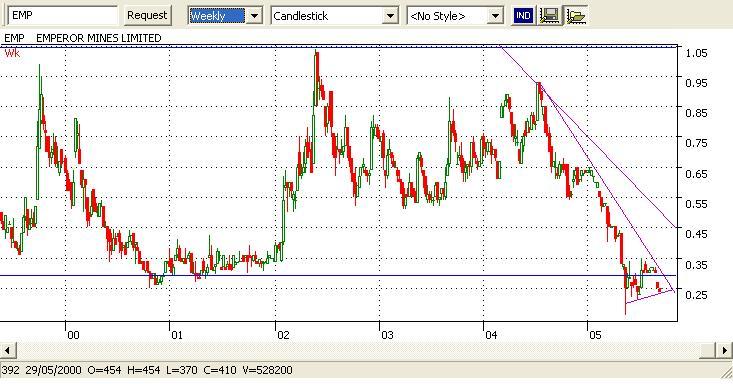
- Emperor Mines (EMP): Emperor's Vatakoula UG mine in Fiji has one of the longest lives of any in the world. I remember this company from its heydays in the 1980s, when the stock was trading at $12. Some 20 years later, it is still producing 110-140,ooooz/year, albeit at higher operating costs. Its record over that time has been chequered, but what can you expect when the prior MD was an accountant. Nevertheless this is a difficult mine. For starters its a 'hot' volcanic mine requiring refrigeration. Grade control & reserve calculations are spirilous because of the irregular distribution of the gold. The veins are thin, so mine headings are narrow. Having visited this mine, I can say workers are confronting some of the hardest conditions in the western world, excluding South Africa. Little surprise that strikes are common. The last 6mths has been shocking after a mine flooding, shaft equipment failure, high oil (thus power) costs and higher
 maintenance costs. The mine went from $6-8mil 6mth profit to a $33mil annual loss. The management team has abandoned the mine, opening the project to fresh ideas. DRD Gold's takeover demonstrates the value inherent in this minem having secured 49% of the equity. Conversion of their loans into convertibles suggests this might increase. Regardless, the bad news seem to be behind them. They still have a respectable 3.3Moz of gold resources at an average grade of 12g/t. The company has $6mil in cash and its debt will be reduced by $8mil if Alcaston can negotiate the sale of the Tavolu project (0.4Moz in Fiji). The Net Tangible Asset value of the company is $0.18, and the share price is $0.26. Being a significant gold producer (albeit high cost) presents an attractive turnaround story at a time of rising gold prices, particularly if they succeed in returning gold production to 140,000 oz per annum. Higher oil prices and continued operational problems pose the biggest concerns. See the chart below - I see scope for a break-out.
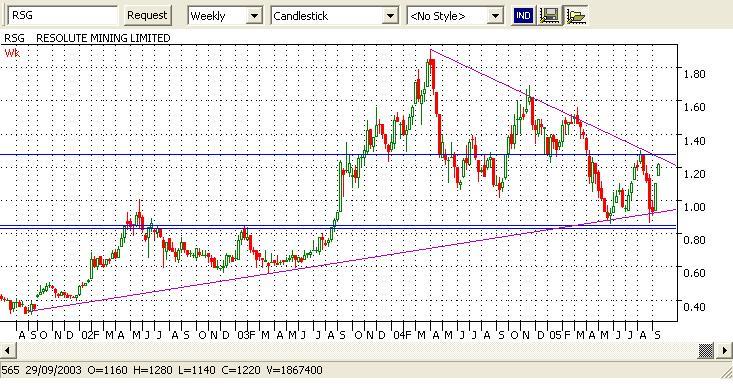
 - Resolute Gold (RSG): They operate 3 gold mines in Australia (Ravenswood) and Africa (Ghana & Tanzania) producing around 230,000 0z per annum. They have alot of blue-sky upside to expand resources, and I wouldnt be surprised to see a merger with Gallery Gold (GGN) to expand their market profile with institutions. They have a significant about of hedging, but expanded output will create added upside. The chart suggests the best opportunity to buy has been missed. Wait to see if resistance at $1.30 is broken, as a better entry might come yet. ie. A delayed wedge breakout.
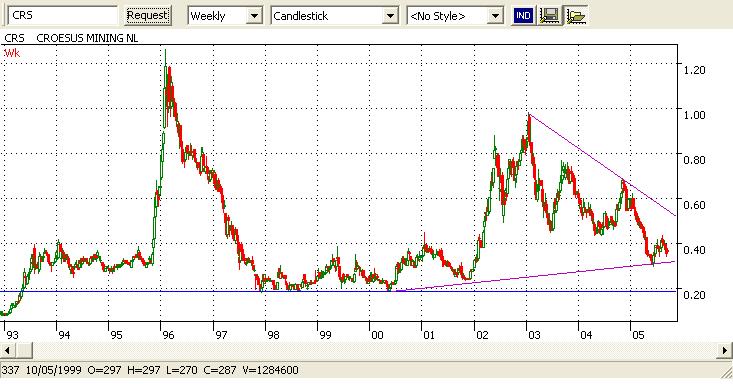
- Croesus Gold (CRS): CRS operates in 3 districts of WA. The company operates mines in the Binduli, Davyhurst and Norseman areas of WA. Production is currently running at 183,000 oz per annum. The company has hedged 21% of its reserves. It has recently increased its total resource base to 3.6Moz, and the company has raised $15mil through a convertible note issue to fund an exploration program in the Norseman area, as well as acquisitions overseas. The notes raises CRS cash reserves to $21mil + $4mil in investments. The project has significant upside in underground resource potential. The institutions dont like it because it lacks a large resource base and has high operating costs. The chart suggests weakness in CRS despite higher gold prices. The reason is the deterioration in cash operating costs the Davyhurst (and Binduli) operations. Their 329mil shares at 36c are worth $118mil. Look for support at 35c, otherwise weakness to 20c. See chart below.
Subscribe to:
Posts (Atom)
Japan Foreclosed Property 2015-2016 - Buy this 5th edition report!

You can view foreclosed properties listed for as little as $US10,000 in Japan thanks to depopulation and a culture that is geared towards working for the state. I bought foreclosed properties in Japan and now I reveal all in our expanded 350+page report. The information you need to know, strategies to apply, where to get help, and the tools to use. We even help you avoid the tsunami and nuclear risks since I was a geologist/mining finance analyst in a past life. Check out the "feedback" in our blog for stories of success by customers of our previous reports.
Download Table of Contents here.


 Posts
Posts

